
Every business is reconsidering its capital expenditure budget. As interest rates continue to rise and an uncertain economic climate dampens business confidence, this is to be expected. Having said that, businesses must keep moving. For those that rely on compressed air, taking a closer look at running costs is a smart business decision.
Traditionally, when purchasing an industrial-grade air compressor, the initial price is often a primary consideration. However, the purchase price is only part of the equation. Over the working life of an air compressor, electricity consumption, maintenance, servicing, and equipment reliability can significantly impact the overall cost.
For Australian businesses that regularly operate compressed air systems, understanding these ongoing expenses helps identify opportunities to reduce costs, improve efficiency, and make better purchasing decisions.
Let’s look at the factors that influence air compressor running costs and what businesses should consider when investing in compressed air equipment.
Over the working life of an air compressor, electricity consumption, maintenance, servicing, and equipment reliability can impact the overall cost.
Understanding the total cost of ownership
The total cost of ownership (TCO) considers all expenses associated with purchasing and operating an air compressor throughout its working life. These typically include the initial purchase price, electricity consumption, scheduled maintenance, replacement parts, repairs and potential downtime.
For compressors operating for extended periods, electricity consumption makes up the largest proportion of lifetime costs. The actual cost depends on several factors, including motor power, operating hours, electricity tariffs, air demand and how efficiently the compressor operates.
For example, consider a 15kW compressor operating at an average electrical input of 15kW for 2,000 hours annually.
At an assumed electricity rate of $0.30 per kilowatt-hour, the annual electricity cost would be approximately $9,000. Over five years, that represents $45,000 in electricity alone, excluding maintenance and other operating expenses. This simplified example highlights why energy efficiency deserves careful consideration when selecting compressed air equipment.
Fixed-speed versus variable-speed compressors
An important consideration is whether a fixed-speed or variable-speed drive (VSD) compressor is most appropriate.
Fixed-speed compressors run their motors at a constant speed. They can be an economical choice for businesses with relatively consistent compressed air requirements.
Variable-speed compressors adjust motor speed to respond to changing air demand, potentially reducing unnecessary energy consumption.
For businesses where compressed air requirements fluctuate throughout the day, VSD technology will deliver meaningful electricity savings. This doesn’t mean variable-speed compressors are automatically the best solution for every application. The most appropriate technology depends on operating patterns, system requirements and expected utilisation.
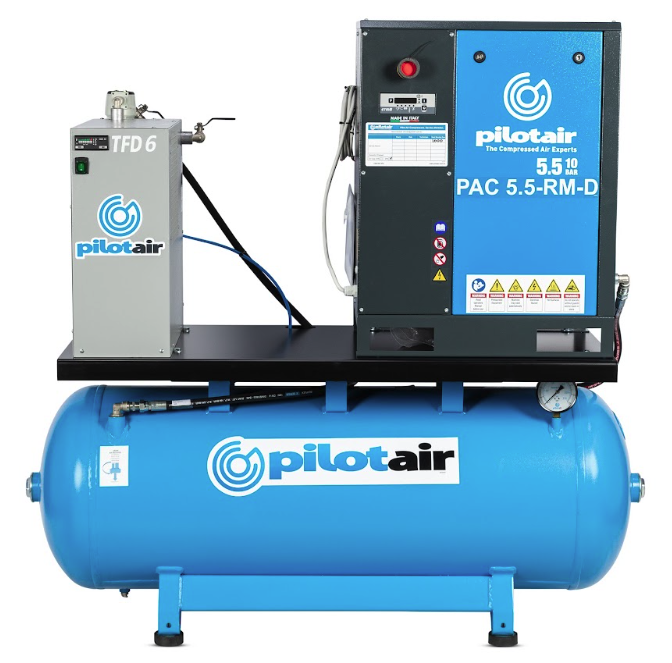
Pilot Air range includes the premium-level ALTA-TEC variable-speed and the workhorse NGS variable-speed rotary screw compressors, providing options for different industrial applications. The PAC range air compressors meet the needs of businesses for which a fixed-speed air compressor is the most suitable option.
Speaking with our technical team is highly recommended. They have the expertise to assess your needs and recommend either a fixed- or variable-speed compressed air system.
Compressor sizing will make a difference
An often overlooked consideration is compressor size. Selecting the right compressor capacity is critical to managing operating costs. An undersized compressor may struggle to maintain adequate pressure during periods of high demand.
Conversely, an oversized compressor can lead to unnecessary capital expenditure and inefficient operation, particularly when the system spends considerable time running unloaded.
Understanding the required free air delivery, operating pressure and anticipated usage patterns helps businesses select equipment suited to their actual requirements. A professional compressed air assessment will identify opportunities to improve existing system performance.
Maintenance and equipment reliability
Regular maintenance is essential. Air filters, lubricants, and other components require inspection and replacement according to the manufacturer’s recommendations. Neglected maintenance can increase energy consumption, contribute to premature component wear and create unexpected equipment failures.
For businesses that rely on compressed air for production, an unplanned shutdown can be considerably more expensive than routine servicing.
Access to qualified technicians, replacement parts and reliable after-sales support should be considered when comparing compressor suppliers. Pilot Air excels in this space. Our onshore technicians are highly skilled. Our spare parts division is fully stocked, and customers don’t have to wait weeks for a replacement part; our after-sales support can’t be beaten.
How to reduce compressed air operating costs?
While we can’t control energy prices, there are some practical steps businesses can take to improve compressed air efficiency without necessarily replacing their existing equipment.
Air leaks are a common source of wasted energy. Ensuring regular inspections and making repairs can reduce unnecessary compressor operational issues. Maintaining appropriate system pressure, replacing blocked filters and reviewing compressor operating schedules can also improve efficiency.
Where compressed air demand varies significantly, reviewing compressor controls and system configuration may identify additional savings.
An air compressor system should be designed around your business needs with an eye on the future; after all, it is a long-term business investment. Understanding electricity consumption, air delivery, maintenance requirements, compressor sizing, usage, and operating hours provides a more accurate picture of lifetime costs.
Speaking with compressed air experts helps businesses evaluate the total cost of ownership and make informed decisions that can result in measurable savings over the lifetime of the compressed air system.
An air compressor system should be designed around your business needs with an eye on the future.

Air compressors you can rely on
For Australian businesses looking to upgrade their compressed air systems, Pilot Air offers a compelling combination of efficiency, capability, and value, making us a smart choice for your next compressed air investment.
Pilot Air is proudly Australian-owned and independent, with onshore maintenance and service, skilled technicians, and a large inventory of spare parts.
Contact our team today.

