
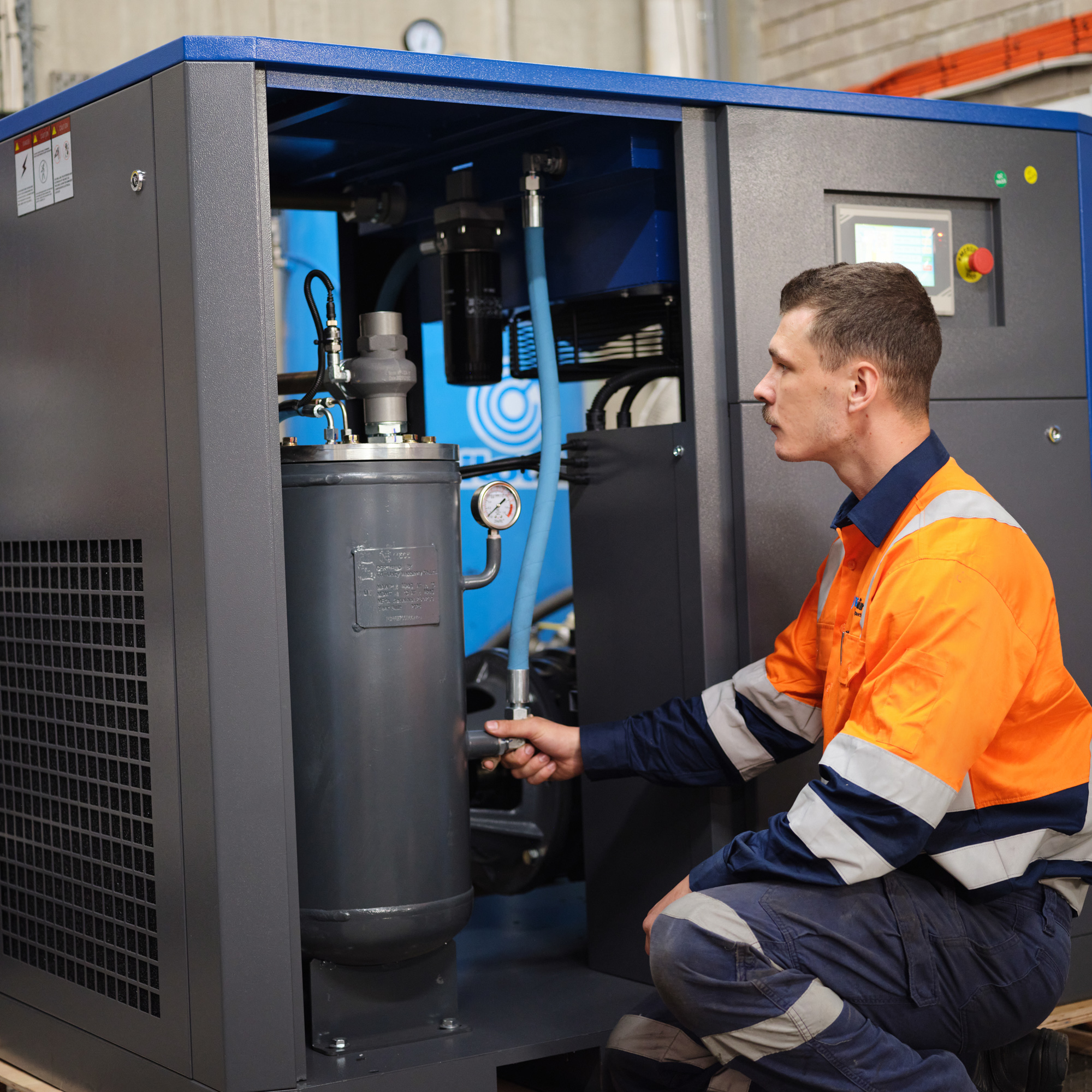
Buying or upgrading an industrial air compressor can seem straightforward. Work out how much air you need, select a compressor that appears to meet the specification and arrange installation. In reality, the compressor is only one component of a much larger compressed air system.
For industrial applications, decisions around compressor capacity, pressure, air quality, storage, treatment, pipework, layout and control all influence performance. Get these decisions right, and compressed air becomes a reliable and efficient utility. Get them wrong, and businesses can face pressure drops, excessive energy consumption, moisture problems, inadequate capacity and unnecessary downtime. That is why there is real value in having technical experts in compressed air assess the entire facility before recommending equipment.
The best compressed air solution starts with understanding the facility, not just selecting a compressor.
Start with the facility, not the compressor
Every industrial facility is different. A manufacturing plant operating multiple production lines has very different compressed air requirements from those of a food processing facility, engineering workshop, or distribution centre.
Even two businesses performing similar work may have different demand profiles, operating hours, machinery, pipework layouts and plans for future expansion. Rather than starting with a compressor catalogue, the better approach is to start with the application.
Pilot Air’s technical team can conduct an on-site diagnostic assessment to understand factors such as existing infrastructure, air demand, pressure requirements, usage patterns, energy consumption, and future capacity needs. Advanced data logging can also provide measurable information about peak demand and how compressed air requirements fluctuate throughout the operating cycle. This information provides the foundation for an engineered solution rather than an educated guess.
Correct sizing delivers long-term value
Bigger isn’t necessarily better. An undersized compressor may struggle to maintain pressure during periods of peak demand. Conversely, simply installing a much larger compressor to provide additional capacity can introduce unnecessary capital and energy costs.
The objective is to understand what the facility actually requires and select the appropriate technology and capacity. Depending on the application, this might mean a fixed-speed compressor, a variable-speed rotary screw compressor, additional air receivers, multiple compressors or a carefully designed combination. The system can be designed with scalability in mind, allowing the compressed air infrastructure to support future production requirements rather than requiring replacement as the business grows.
Look beyond the compressor
A high-quality compressor connected to poorly designed infrastructure will never deliver its full potential. Pipe diameter, distance, bends, distribution layout, storage capacity, filtration, and drying all affect the air that eventually reaches machinery and equipment.
Technical expertise allows these elements to be considered as one integrated system. Pilot Air can design layouts that minimise pressure drop, incorporate appropriately sized receivers to manage demand variations, and specify dryers and filtration to deliver the required air quality. This is particularly important in industrial applications where moisture, contaminants or inconsistent pressure can affect equipment performance, production quality or finished products.
Design, install, test and commission as one solution
An advantage of working with a complete compressed air solutions provider is continuity throughout the project. At Pilot Air, we design compressed air systems in-house, individually test systems for quality control and use specialist technicians for installation. Our broader capability extends across assessment, design, manufacture, testing, installation, commissioning, servicing and maintenance.
This integrated approach means the people installing and commissioning the infrastructure understand what the system was designed to achieve. Commissioning is important. It provides an opportunity to verify that the installed system operates as intended and ensure the compressor and supporting infrastructure work together under real operating conditions.
Consider the whole-of-life cost
Purchase price is important, but industrial compressed air should also be considered in terms of its whole-of-life value. Energy consumption, maintenance, downtime, productivity and the ability to expand the system can have a much greater financial impact than the initial equipment cost.
A technically informed design identifies opportunities to minimise energy losses, reduce unnecessary compressor cycling, maintain consistent pressure and make future servicing or expansion easier. Pilot Air’s approach is to assess the full compressed-air requirements and configure the infrastructure to meet immediate and long-term needs.
Remove the guesswork
For a small workshop with relatively simple air requirements, selecting a compressor may be straightforward. For an industrial facility where compressed air is integral to production, much more is at stake. Having technical experts access the facility, understand the application and engineer the complete system removes much of the guesswork.
With more than 40 years of compressed air experience, our team manages the process from initial site assessment and system design through to manufacture, testing, installation, commissioning and ongoing support. We ensure you have the right capacity, reliability, efficiency and scalability for your business now and in the future.
Expert assessment, design and commissioning remove the guesswork and deliver compressed air infrastructure built for long-term performance.

Air compressors you can rely on
For Australian businesses looking to upgrade their compressed air systems, Pilot Air offers a compelling combination of efficiency, capability, and value, making us a smart choice for your next compressed air investment.
Pilot Air is proudly Australian-owned and independent, with onshore maintenance and service, skilled technicians, and a large inventory of spare parts.
Contact our team today.

