
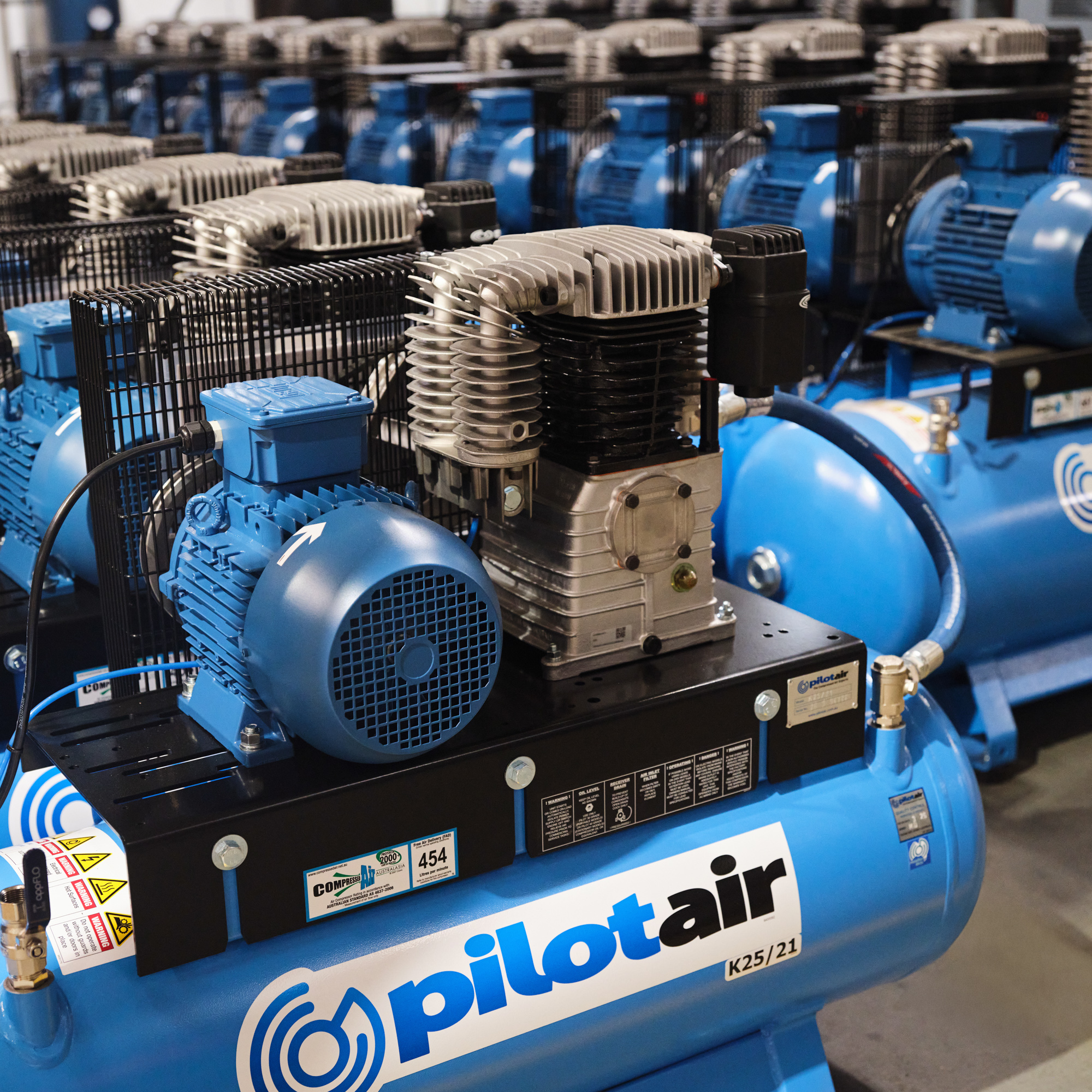
Which air compressor is the right one for the job? As the National Sales Manager at Pilot Air, I, along with the team, am aware that choice is everywhere and choosing an air compressor can quickly become confusing.
There are different technologies, motor sizes, tank capacities, pressure ratings and airflow specifications to compare. As specialists in the compressed air industry, we understand the configurations that make up an air compressor system tailored for a particular job, industry or facility. However, our customers are specialists in their fields, and knowing the ins and outs of compressed air isn’t always a top priority for them.
At Pilot Air, we supply air compressors for everything from home workshops and trades through to construction, automotive workshops, manufacturing and heavy industrial facilities. While the scale changes considerably, the basic principle remains the same: the right compressor is the one that can reliably meet the demands of your application.
In this article, I sort some common applications and what you should consider.
Our customers are specialists in their fields and knowing the ins and outs of compressed air isn’t always a top priority for them.
Lets start with a common usage sector: Tyre inflation and general DIY
This is a hugely popular market segment and fits everyone from the home user to the generalist handyman. There are literally hundreds of different types of compressors and brands that target this consumer segment.
Our recommendation is to consider your usage. Generally, this cohort uses an air compressor to inflate tyres, blow down equipment, and handle occasional DIY jobs. The compressed air demand is relatively low and intermittent.
A reciprocating or piston compressor can be a practical choice. Consider how frequently you will use the compressor, the tools you may want to add in the future, available power and whether portability is important.
As a general guide, a 1.5–2.2 kW reciprocating compressor is suitable for many home workshops and DIY applications. Around 2.2 kW provides a useful all-round starting point if you also want the flexibility to run a wider range of pneumatic tools, while still remaining within the size range commonly suited to single-phase power. A portable petrol or diesel model is also a consideration when on the road.
Don’t automatically choose the smallest compressor available. If your DIY ambitions extend to pneumatic tools or spray painting, additional airflow and receiver capacity may prove useful.
Nail guns and pneumatic tools
Nail guns use compressed air in short bursts, making them suitable for many smaller compressor systems. Pneumatic drills, sanders, grinders, and impact wrenches can have significantly higher airflow requirements, particularly when used for extended periods.
For lighter-duty applications such as nail guns and intermittent use of pneumatic tools, Pilot Air’s K17SD provides a useful starting point. It features a 1.65 kW motor, 100-litre receiver and 205 L/min free air delivery, operating from a 240V 10-amp power supply.
For a little more capacity, the K17-50 and K17-90 both use 2.2 kW motors and deliver 257 L/min free air delivery, with the choice of a 50- or 90-litre receiver. These can provide a good step-up for trade and workshop users operating a wider range of pneumatic tools.
Another option is the TM420SD+ Trade Series, which combines a 2.2 kW motor, 50-litre receiver and 256 L/min free air delivery in a compact unit specifically designed for trade and DIY applications.
For more demanding pneumatic tool use, the K25SDL moves up to 289 L/min free air delivery, a 2.2 kW motor and 100-litre receiver, with a two-stage pump and maximum pressure of 160 PSI.
As a general guide, around 1.65–2.2 kW is a useful starting range for nail guns and many pneumatic tool applications, but motor size shouldn’t be considered in isolation. Check the airflow and operating pressure required for each tool, and consider how long each will operate and whether several tools will be used simultaneously.
Spray painting
Spray painting is a good example of why compressor selection isn’t simply about maximum pressure. A spray gun requires a consistent air volume over an extended period, so free air delivery can be particularly important. For smaller or intermittent spray-painting jobs, a larger reciprocating compressor can provide a practical starting point. As the duration and frequency of spraying increase, additional capacity becomes important, particularly when other air tools are used simultaneously.
Pilot Air’s K30 range provides a significant step up in capacity, with models delivering approximately 681 L/min free air delivery from a 5.5 kW motor. For applications requiring still greater airflow, the K50 range increases capacity to approximately 888 L/min with a 7.5 kW motor.
For professional workshops that require compressed air throughout the day, Pilot Air’s PAC rotary screw range, starting at 4kW, offers another option. Rotary screw technology is designed for more continuous air demand and may be relevant where spray painting is one of several compressed-air applications.
Always check the airflow requirements of the specific spray equipment, as spray guns can vary considerably.
Construction sites
Construction introduces another consideration, namely, where will the compressed air come from? Access to mains electricity may be limited or impractical, making a petrol-or diesel-powered compressor a logical option for mobile applications.
Pilot Air’s petrol reciprocating range includes options designed specifically for trade and field use. The K17PUTE, for example, is designed with tradies, farmers and ute owners in mind and can be installed in a vehicle tray to provide compressed air on the go.
For larger requirements, the K50P Classic Industrial Series petrol compressor provides a heavy-duty, Australian-built option for sites that require greater compressed air capacity.
The right choice depends on the pneumatic tools being operated, how many will be used simultaneously and how frequently they will run. Portability and installation also matter, particularly if the compressor will be permanently mounted on the vehicle.
Automotive workshops
Automotive workshops are a significant part of our customer mix. Compressed air is a pivotal piece of infrastructure that powers impact wrenches, tyre equipment, air tools, spray equipment, and other pneumatic systems.
For smaller workshops with intermittent demand, Pilot Air’s K30 reciprocating range can provide a useful starting point, delivering approximately 681 L/min from a 5.5 kW motor.
Where demand increases, the K50 steps up to approximately 888 L/min from 7.5 kW, making it an option for workshops running more equipment or experiencing greater simultaneous demand.
For workshops that require consistent compressed air throughout the working day, rotary screw technology is worth considering. The NGS 7.5VS is specifically suited to applications including automotive workshops, delivering up to 18.33 L/s at 8 bar from a 7.5 kW variable-speed rotary screw compressor.
For a busy automotive workshop, we highly recommend speaking to one of our technical advisers. We’ve delivered numerous compressed air solutions to this industry, and our expertise can help future-proof your business and reduce energy costs.
Cabinetmaking and woodworking
Cabinetmaking and woodworking businesses use compressed air for nail and staple guns, spray finishing, CNC equipment, cleaning and automated machinery.
A smaller workshop with intermittent demand may be well served by one of Pilot Air’s larger K-Series reciprocating compressors. The K30 and K50 ranges, for example, provide options from approximately 681 to 888 L/min free air delivery.
As production increases and compressed air is required more consistently, rotary screw technology may become a better fit. Pilot Air’s PAC 4 and PAC 5.5 fixed-speed rotary screw compressors provide 4 and 5.5 kW options designed for continuous workshop and industrial operation.
For businesses with changing air demand, the NGS 7.5VS is the logical step. Its variable-speed technology adjusts output to demand, making it suitable for woodworking shops and small manufacturing operations that require a reliable, continuous supply without the high capital expenditure of our tier-one ALTA-TEC models.
Fabrication and engineering workshops
Pilot Air have real legacy experience in designing and installing compressed air solutions for fabrication and engineering workshops of all sizes. This industry generally requires multiple compressed-air applications, including pneumatic tools, machinery, plasma cutting, cleaning, and powering production equipment.
Where demand is continuous, Pilot Air’s PAC rotary screw range starts at 4 kW and extends through progressively larger 75kW industrial configurations.
Another option is the NGS variable-speed range, starting with the 7.5 kW NGS 7.5VS and extending through 11, 15, 22, and 37 kW, as well as considerably larger models. The NGS range also features the NGS 15VS-16 Bar specifically engineered for laser cutting applications. These next-generation models from Pilot Air are becoming increasingly relevant in the industrial space due to their cost of entry, warranty, and performance.
Manufacturing and heavy industrial applications
In manufacturing and heavy industry, compressed air is an essential utility, powering everything from pneumatic cylinders, actuators and automated machinery to production equipment, tools, packaging systems and specialised processes.
At this level, the entire site needs to be considered, including current and peak air demand, operating pressure, air quality, production schedules, energy consumption, pressure losses, distribution, redundancy and potential future expansion.
This is where our specialist onsite assessment and diagnostics become valuable. Our team audits your existing compressed air requirements and takes a detailed look at how air is generated, treated, stored, and distributed throughout the facility. We can also identify opportunities to improve energy efficiency and ensure the system delivers the right combination of power, pressure, capacity, and distribution.
For these applications, an off-the-shelf solution is rarely appropriate. We customise the design, manufacture, and installation of a tailored compressed air solution.
From a growing manufacturing facility to a complex industrial operation with multiple production areas and specialised air requirements, we have the range and expertise to meet even the most demanding needs.
Regardless of your industry, our role is to understand exactly what your operation requires and design a reliable, efficient and future-proof compressed air system around it.
I trust you have found this helpful and don’t hesitate to contact us for advice, service or product recommendations. We have Australia covered with onshore technicians and an impressive network of Pilot Air distributors nationwide.
Our role is understand exactly what your operation requires and design a reliable, efficient and future-proof compressed air system around it.

Air compressors you can rely on
For Australian businesses looking to upgrade their compressed air systems, Pilot Air offers a compelling combination of efficiency, capability, and value, making us a smart choice for your next compressed air investment.
Pilot Air is proudly Australian-owned and independent, with onshore maintenance and service, skilled technicians, and a large inventory of spare parts.
Contact our team today.

