
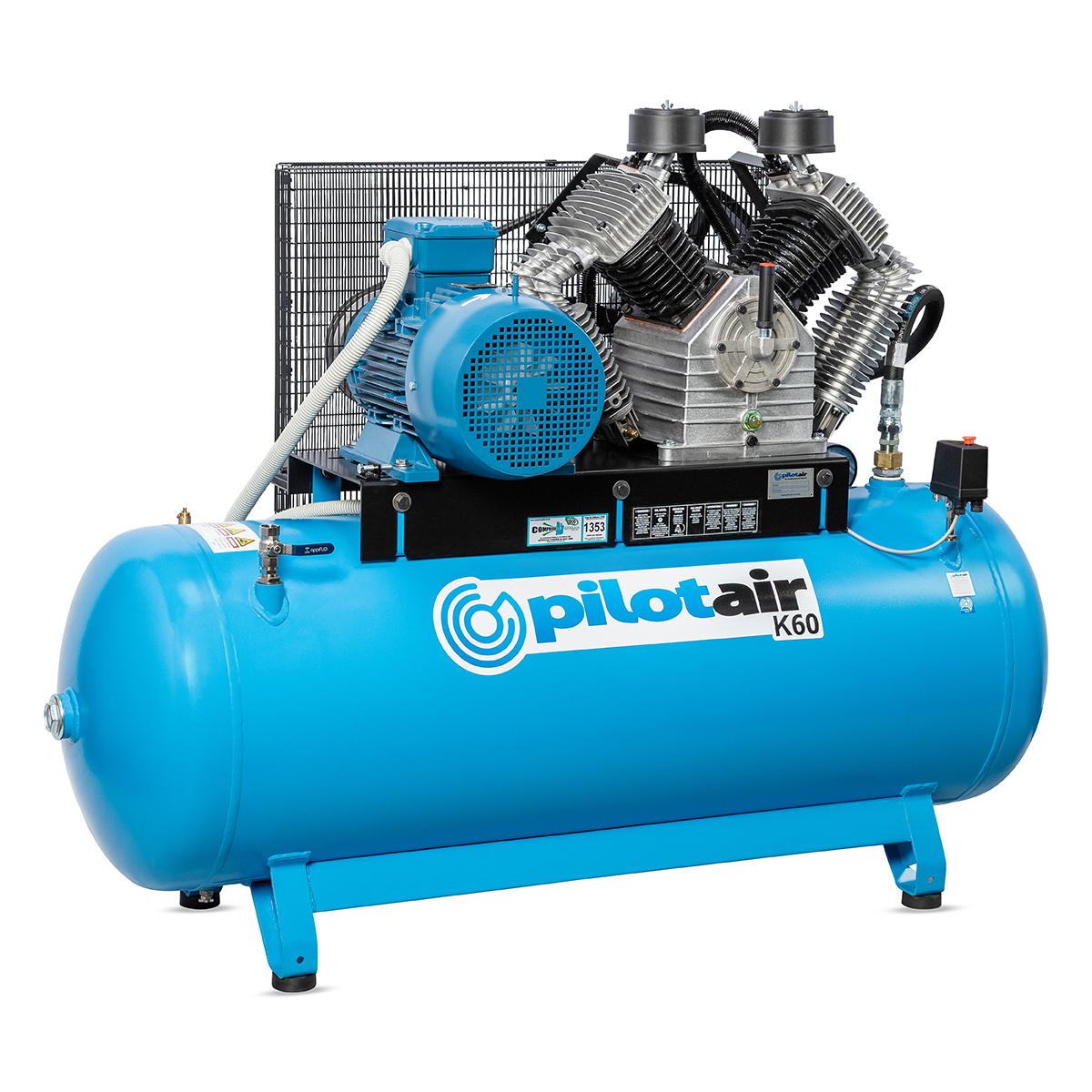
Walk into most busy automotive workshops, engineering facilities, or manufacturing operations, and you’ll find a compressed air system working away in the background. From powering pneumatic tools to operating machinery and production equipment, compressed air is an essential part of modern industry.
However, not every application requires the same level of performance. A small workshop running a couple of air tools has very different requirements from a manufacturing facility operating multiple machines throughout the day. This is where three-phase reciprocating air compressors come into their own.
At Pilot Air, we’ve been supplying compressed air solutions to Australian businesses for over 45 years. Our range of three-phase industrial reciprocating compressors is designed to deliver dependable performance across a broad range of commercial and industrial applications.
At Pilot Air, we've been supplying compressed air solutions to Australian businesses for over 45 years.
What is a three-phase reciprocating air compressor?
Let’s start with the basics. A reciprocating air compressor uses pistons moving within cylinders to draw in atmospheric air, compress it and deliver it into a storage receiver. As pressure builds, the compressed air becomes available to power tools, machinery and other equipment.
Unlike single-phase compressors commonly found in smaller workshops, three-phase models operate using a three-phase electrical supply, typically available in commercial and industrial facilities.
Three-phase motors are suited to higher-powered equipment, offering efficient power delivery, reliable starting performance, and the capacity to operate larger compressor pumps.
Importantly, reciprocating compressors are recommended for applications with intermittent or fluctuating air demand, in which the compressor can cycle between operating and resting periods.
Where are three-phase reciprocating compressors used?
Three-phase reciprocating air compressors are suitable for a broad range of industries. We supply our range of units across automotive workshops and panel beaters, engineering and fabrication, manufacturing, agriculture and maintenance facilities.
The common denominator is the need for reliable compressed air at sufficient pressure and volume to support the equipment being used. So long as the site has a three-phase electricity supply, which is commonly available in factories, industrial facilities and larger commercial workshops. Businesses operating from smaller premises may need to arrange an electrical upgrade before installing a three-phase compressor. It’s important to confirm the available power supply before selecting a compressor.
Understanding the different sizes and capabilities
One of the advantages of Pilot Air’s three-phase industrial compressor range is the variety of capacities available. Our Classic Industrial Series extends from compact 2.2kW units through to substantial 15kW compressors designed for more demanding applications.
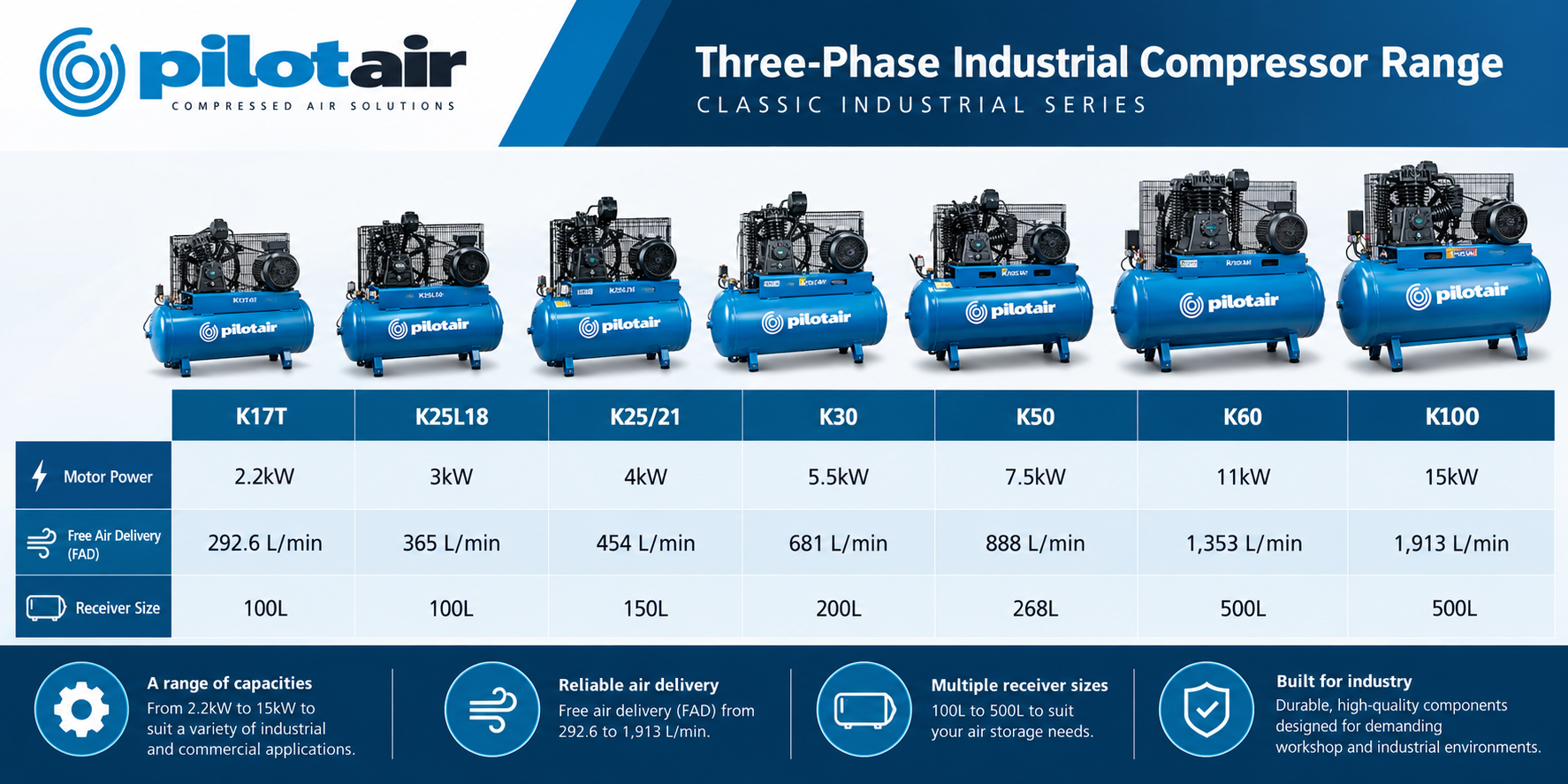
Smaller models can suit workshops operating individual pneumatic tools, while larger compressors provide greater airflow capacity for multiple users or more demanding equipment.
However, choosing the right compressor isn’t simply about buying the largest motor or receiver available. It is important to get the right advice. Our technical team is here to help you choose the right air compressor for your needs.
What does free air delivery actually mean?
Free air delivery, commonly referred to as FAD, is one of the most important specifications when comparing air compressors. Put simply, FAD measures the volume of usable compressed air a compressor delivers, expressed as an equivalent volume of air at reference inlet conditions.
It is generally quoted in litres per minute (L/min). Why does this matter?
Every pneumatic tool or piece of equipment requires a certain volume of air at a specified operating pressure. If the compressor cannot deliver sufficient airflow, performance can suffer. For example, Pilot Air’s K30 delivers 681 L/min of free air, while the larger K50 delivers 888 L/min.
That additional capacity can make a significant difference when operating multiple tools or equipment with higher airflow requirements.
FAD differs from a compressor’s theoretical piston displacement. FAD provides a more practical indication of actual air delivery, provided the measurement conditions are comparable. When selecting a compressor, businesses should consider the combined airflow requirements of equipment operating simultaneously, the required working pressure and an allowance for future growth.
What about receiver size?
The receiver is the storage tank that holds compressed air. Larger receivers provide additional stored-air capacity, helping accommodate short periods of peak demand and reducing frequent compressor starts.
However, a larger receiver doesn’t increase the compressor’s actual air delivery. If equipment consistently consumes more air than the compressor produces, a bigger tank alone won’t solve the problem.
Choosing a compressor that works for your business
Three-phase reciprocating compressors offer a practical combination of durability, versatility and performance. Pilot Air’s industrial range incorporates robust components, including cast-iron cylinders and Italian-made pumps, engineered for demanding workshop and industrial environments.
For businesses requiring clean, dry compressed air, we also offer complete packages incorporating refrigerated air dryers and industrial filtration.
Ultimately, selecting the right compressor comes down to understanding how your business uses compressed air, rather than focusing on motor size alone. At Pilot Air, our experienced team can assess your airflow requirements, operating pressures, equipment demands and future expansion plans to recommend a suitable solution.
Whether you’re upgrading an existing workshop compressor or planning a new industrial compressed air system, we’re here to help you get the specification right from the start.
Ultimately, selecting the right compressor comes down to understanding how your business uses compressed air.

Air compressors you can rely on
For Australian businesses looking to upgrade their compressed air systems, Pilot Air offers a compelling combination of efficiency, capability, and value, making us a smart choice for your next compressed air investment.
Pilot Air is proudly Australian-owned and independent, with onshore maintenance and service, skilled technicians, and a large inventory of spare parts.
Contact our team today.

